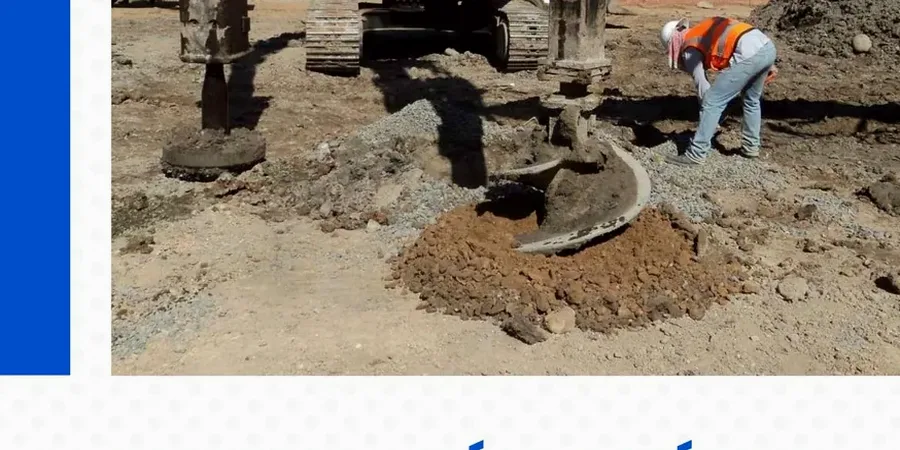
The fine-grained lacustrine silts and soft clays that define Chilliwack's soil profile across the eastern Fraser Valley present a direct challenge for shallow foundations. More than once we have sampled boreholes near the Vedder River where SPT blow counts drop below 6 in the upper four metres, a condition that demands ground improvement before any structural load can be transferred safely. Stone column design steps in precisely here: by replacing roughly 15 to 30 percent of the weak matrix with compacted granular columns, we create a composite ground mass with substantially higher stiffness and drainage capacity. For sites between Promontory and Sardis where floodplain deposits meet residual glacial till, combining the vibro-replacement logic with a seismic microzonation study helps quantify the stiffness contrast needed to meet NBCC spectral acceleration requirements. The design process relies on unit cell settlement and bearing capacity models calibrated against CPT soundings and laboratory consolidation data, ensuring every column group matches the actual stratigraphy of Chilliwack's post-glacial basin.
A properly drained stone column network can cut primary consolidation settlement by half in Chilliwack's lacustrine silts while providing a reliable drainage path for earthquake-induced pore pressures.
Site-specific factors
Chilliwack sits within a high seismic hazard zone where the NBCC 2020 assigns a short-period spectral acceleration Sa(0.2) exceeding 0.7g on Site Class C. When the same motion reaches the Site Class E silts of the Vedder fan, amplification factors push the demand well above what untreated ground can sustain without liquefaction or cyclic softening. Stone columns mitigate this risk through three mechanisms: densification of the surrounding soil during installation, reinforcement of the matrix with stiff inclusions, and rapid drainage that shortens the earthquake-induced pore pressure pulse. A single-family residential pad near the Chilliwack River that omitted ground improvement would likely see post-seismic settlements on the order of 50 to 80 millimetres, cracking slab-on-grade floors and severing utility connections. Our design workflow integrates SPT-based liquefaction triggering per Youd & Idriss with Priebe's settlement reduction curves, producing column layouts that keep total and differential movement within tolerable limits for the structure type. The process also requires verification load tests on sacrificial columns, correlating modulus values back to the FHWA design assumptions.
Frequently asked questions
What is the typical cost range for stone column design and testing in Chilliwack?
For a standard residential or light commercial site in Chilliwack, the combined geotechnical investigation, stone column design package, and post-installation verification testing generally falls between CA$1,940 and CA$7,870, depending on the number of columns, treatment depth, and the extent of CPT profiling required.
How do you confirm that stone columns will prevent liquefaction under NBCC seismic loads?
We start with SPT or CPT data to compute the factor of safety against liquefaction triggering using the Youd & Idriss (2001) procedure. Then we apply Priebe's method to estimate settlement reduction from the stone column grid, verifying the results with post-installation CPT soundings that measure the actual increase in penetration resistance between columns.
What depth of soft soil in Chilliwack typically requires stone columns instead of shallow footings?
When the soft compressible layer exceeds roughly 2.5 to 3.0 metres in thickness beneath the footing influence zone, stone columns become a cost-effective alternative to deep foundations. In Chilliwack's Fraser Valley deposits, we commonly design columns to depths between 6 and 14 metres, terminating in the dense pre-Vashon till that provides a competent bearing stratum.