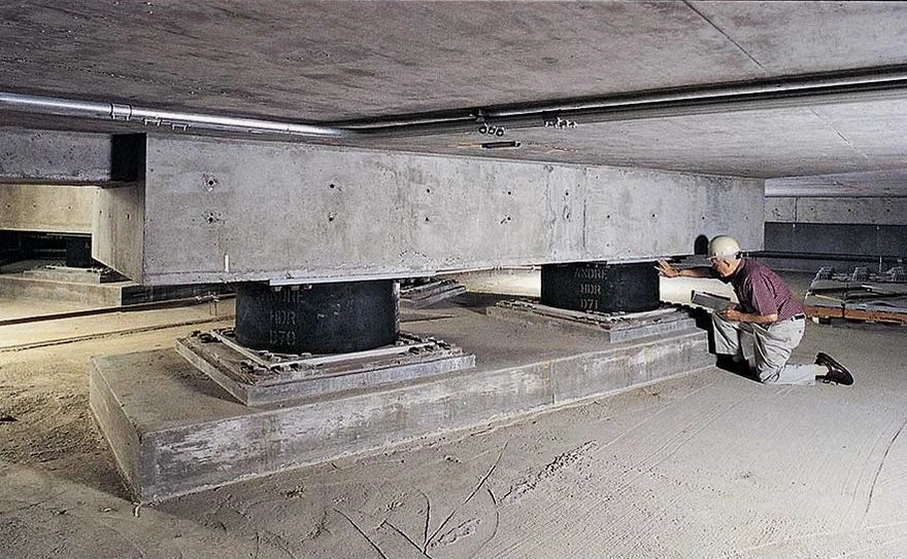
Chilliwack’s growth from a small agricultural stop on the Yale Road to a Fraser Valley hub placed thousands of structures on deep alluvial soils. The 1948 flood reshaped the Vedder River plain, leaving behind loose silts and sands that amplify seismic waves. Base isolation seismic design shifts the strategy entirely—instead of bracing a building to resist shaking, the structure is decoupled from the ground. For Chilliwack projects, this means isolating the superstructure on elastomeric or sliding bearings tuned to the site’s specific spectral response. The NBCC 2020 hazard model assigns the city a moderate-to-high seismic classification, and the soft soil profile beneath much of the valley floor demands a careful isolation period shift. When soil layers suggest liquefaction susceptibility beneath the bearing level, liquefaction assessment data becomes essential input for isolator displacement calculations.
Isolation doesn’t eliminate seismic force—it redirects energy into controlled displacement at a dedicated interface, keeping the structure elastic above.
Our approach and scope
The Fraser Valley’s winter saturation cycle changes everything for isolation system performance. Chilliwack sees over 1,600 mm of annual precipitation, keeping the near-surface silts at high moisture content year-round. This reduces soil stiffness and lengthens the fundamental site period, which in turn influences the required isolation period. A lead-rubber bearing that performs well on Vancouver’s glacial till may need complete re-tuning for the Vedder River fan deposits. Our technical team runs site-specific response spectra using shear-wave velocity profiles from downhole testing, then iterates isolator properties—effective stiffness, yield force, post-elastic ratio—until the superstructure’s modal response stays below damage thresholds. The design process follows ASCE 7-22 Chapter 17 and CSA S832 for seismic isolation, with every isolator prototype tested to three cycles of maximum considered earthquake displacement per ISO 22762. Peer review by a second senior engineer is standard on all Chilliwack base isolation seismic design packages.
Reference standards
NBCC 2020 – National Building Code of Canada, seismic provisions Part 4, ASCE/SEI 7-22 Chapter 17 – Seismic Isolation Requirements, CSA S832-14 (R2019) – Seismic Isolation and Energy Dissipation, ISO 22762-1:2018 – Elastomeric Seismic-Protection Isolators, NCh 2745 (reference for benchmarking displacement models)
Frequently asked questions
What is the cost range for base isolation seismic design of a mid-rise building in Chilliwack?
For a typical mid-rise structure in the Chilliwack area, the design and analysis package generally ranges from CA$5,420 to CA$12,730, depending on building complexity, number of isolators, and the extent of nonlinear time-history analysis required. This covers feasibility screening, detailed design, specification drafting, and peer review coordination.
How does the Fraser Valley soil profile affect isolator displacement?
The deep alluvial silts and sands prevalent across the Vedder River plain amplify long-period ground motion, which directly increases displacement demand on the isolation system. A site period shift from 0.4 s (firm ground) to 0.8–1.2 s (soft soil) can double the required isolator travel, making site-specific response spectra analysis mandatory rather than relying on code-default values.
Which isolator types are best suited for Chilliwack’s seismic hazard?
Lead-rubber bearings and friction pendulum systems are both viable, but the choice hinges on the building’s fundamental period, axial load variation, and the site’s spectral shape. For lighter structures on soft soil, high-damping rubber bearings often provide sufficient energy dissipation without excessive yield force. Heavier structures may benefit from the load-independent period of friction pendulum isolators.
Does base isolation eliminate the need for a geotechnical liquefaction study?
No. Even with an isolation system, the foundation and isolator pedestals must remain stable under MCE shaking. If the bearing stratum is liquefiable, ground improvement—such as vibrocompaction or stone columns—or deep foundations may be required beneath the isolation plane. The isolation design and geotechnical mitigation are interdependent deliverables.
What peer review requirements apply to isolated structures under the BC Building Code?
The BC Building Code requires independent peer review for all seismically isolated structures, conducted by a professional engineer with demonstrated experience in base isolation design. The reviewer examines ground motion selection, isolator modeling assumptions, prototype test results, and moat detailing. Our packages are prepared with this review milestone integrated from the start.