← Home · Laboratory

Laboratory CBR Testing for Pavement Design in Chilliwack

Together, we solve the challenges of tomorrow.

LEARN MORE →

The contrast between the dense glacial till deposits near Promontory Heights and the alluvial silts along the Vedder River flats in Chilliwack means a single pavement design approach never works across the city. We have tested subgrade samples from the Sardis benchlands that delivered soaked CBR values above 20%, while material pulled from low-lying Fairfield Island often struggles to reach 3% once saturated. This variability is exactly why a laboratory CBR test becomes essential before committing to granular base thicknesses for any road, parking lot, or industrial yard in Chilliwack. The Fraser Valley’s high water table and seasonal flooding patterns add another layer of complexity that no empirical correlation from other regions can reliably capture. Running a soaked CBR under controlled ASTM conditions lets us quantify how the local subgrade will behave after a rainy November when construction compaction moisture is long forgotten.

Soaked CBR values in Chilliwack’s low-lying areas can drop below 3%, making laboratory testing the only reliable basis for deciding between a 200 mm or 400 mm granular base.
Our approach and scope

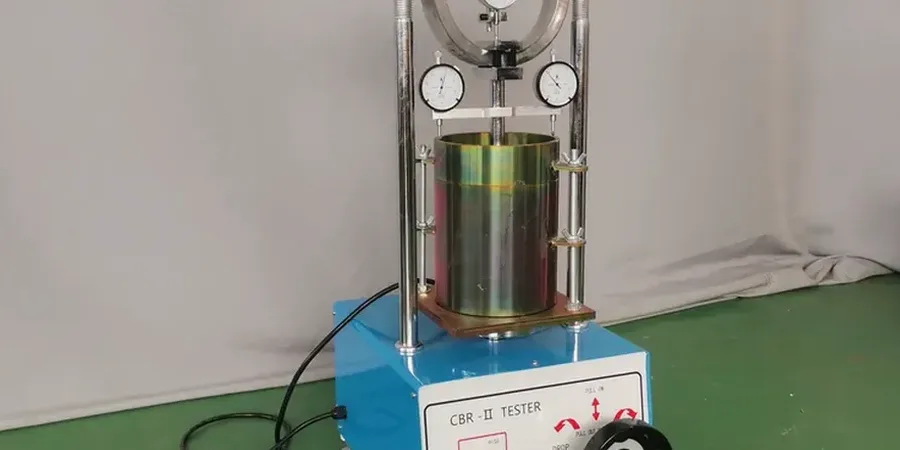
We recently worked on a commercial development off Yale Road where the geotechnical investigation revealed a meter of silty clay overlying a sand lens at depth. The initial field density readings looked acceptable, but the remolded laboratory CBR test at 95% of standard Proctor maximum dry density told a different story—values dropped below the 5% threshold required by the City of Chilliwack’s subdivision bylaw for residential collector roads. We ended up recommending a 300 mm granular sub-base with geotextile separation to bridge the weak layer, a decision supported directly by the CBR curve we generated in the lab. For projects where the subgrade material transitions across the site, pairing the CBR with a grain size analysis helps identify whether fines migration is the root cause of low bearing capacity, and a Proctor compaction test establishes the density target against which the CBR specimen must be prepared. The test itself follows ASTM D1883-21, using a standard 2.54 mm/min penetration rate and a 49.6 mm diameter piston, with readings taken at 0.64, 1.27, 1.91, 2.54, 3.18, 3.81, 4.45, 5.08, 7.62, 10.16, and 12.70 mm penetration. We apply a 4.54 kg surcharge weight to simulate the overburden stress expected under the pavement structure, which makes a measurable difference in Chilliwack’s softer alluvial soils where confinement effects are significant.
Laboratory CBR Testing for Pavement Design in Chilliwack
Technical reference image — Chilliwack

Site-specific factors

Chilliwack’s growth from a small agricultural settlement into a city of over 95,000 residents has pushed development onto marginal land that earlier generations would have left as pasture. The Sumas Prairie area, which spent weeks underwater during the catastrophic November 2021 atmospheric river flood, is now seeing renewed industrial construction interest, and the silty clay subgrades there demand rigorous soaked CBR evaluation because the post-flood moisture regime permanently altered the equilibrium suction in the near-surface soils. Skipping the laboratory CBR test and relying on visual classification or DCP correlations calibrated in drier climates routinely leads to under-designed pavements that rut within two winters. The economic consequence is not just the cost of asphalt replacement but the disruption to agricultural supply chain traffic that depends on those roads during harvest season. Our laboratory has processed over 600 CBR specimens from Chilliwack sites in the past five years, and the pattern is consistent: remolded soaked values average 30 to 40% lower than unsoaked values in the clay-rich units of the Fort Langley Formation that underlie much of the city.

Need a geotechnical assessment?

Reply within 24h.

Email: contact@geotechnicalengineering.xyz

Technical data

ParameterTypical value
StandardASTM D1883-21
Piston diameter49.6 mm (3 in² area)
Penetration rate1.27 mm/min (0.05 in/min)
Specimen compaction95% of γd,max per ASTM D698 / D1557
Soaking period96 hours submerged
Surcharge weight4.54 kg minimum
Typical reporting pointsCBR at 2.54 mm and 5.08 mm penetration

Complementary services

01

Soaked CBR for Pavement Subgrade Design

Remolded specimens compacted at target moisture and density, then submerged for 96 hours before penetration testing. This simulates the worst-case post-construction saturation scenario that Chilliwack’s high water table imposes on road subgrades year after year.

02

CBR Correlation with In-Situ Testing

Laboratory CBR results calibrated against field DCP and plate load tests performed at the same test pit locations. This correlation allows the pavement designer to extrapolate point-specific lab values across the entire alignment using rapid field index testing.

Reference standards

ASTM D1883-21, ASTM D698-12 (Standard Proctor), ASTM D1557-12 (Modified Proctor), BC Ministry of Transportation Supplement to TAC Pavement Design Guide

Frequently asked questions

How does the laboratory CBR test differ from a field CBR or DCP test in Chilliwack’s soils?

The laboratory CBR test per ASTM D1883 gives us full control over moisture content, density, and soaking conditions; we can replicate the subgrade state after years of service under a saturated pavement structure. Field DCP testing is faster and lets us profile multiple points per day, but it measures the soil at whatever moisture condition exists on the day of testing. In Chilliwack’s silty soils, a dry August DCP value can be three times higher than what the same material yields in November. The lab test removes that seasonal uncertainty, so the pavement thickness design is conservative enough for the wet season without being wasteful.

What soaked CBR values are typically required by the City of Chilliwack for residential and industrial roads?

The City of Chilliwack Subdivision and Development Control Bylaw generally requires a minimum soaked CBR of 5% for residential collector roads and 10% for industrial and arterial roadways, measured on specimens compacted to 95% of standard Proctor maximum dry density. If the native subgrade cannot achieve these values, the typical remedy is either a thicker granular base course or subgrade improvement with cement or lime stabilization. We report CBR at both 2.54 mm and 5.08 mm penetration, but the City reviews the lower of the two values as the governing result for design acceptance.

What is the typical cost for a laboratory CBR test in Chilliwack?

A standard soaked laboratory CBR test on a single remolded specimen in Chilliwack typically ranges from CA$140 to CA$280, depending on whether it is part of a larger geotechnical testing program and whether additional compaction or classification testing is required on the same sample. A full pavement evaluation package that includes Proctor compaction, grain size analysis, and two CBR points on the same material generally falls in the CA$500 to CA$900 range.

Location and service area

We serve projects across Chilliwack and surrounding areas. More info.

View larger map