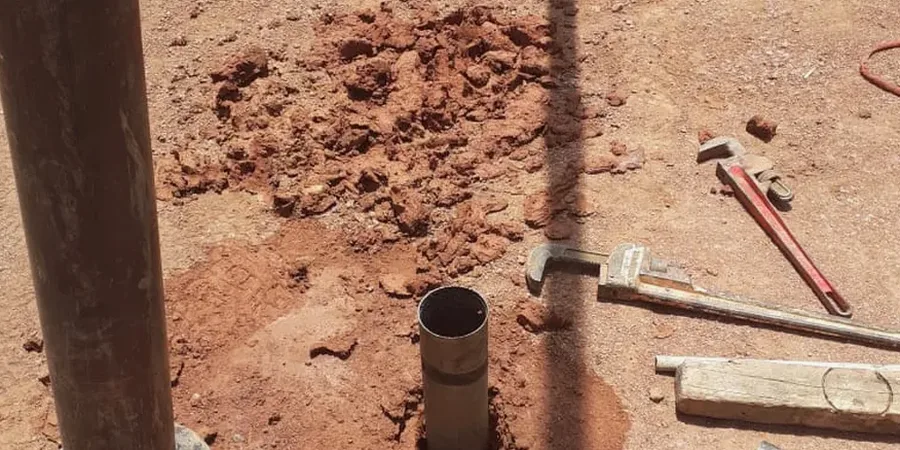
A common mistake in the Fraser Valley is treating all soil as uniformly permeable. Design a retention pond in a gravel lens east of Vedder Mountain and you get a dry hole; assume the same for a silt layer near the Vedder Canal and you have a flooding problem. In Chilliwack, the glaciofluvial deposits create extreme variability in hydraulic conductivity over short distances. The Lefranc test provides direct, in-situ measurements of this parameter at specific elevations within a borehole, cutting through the guesswork. Before sinking a dewatering well or sizing an infiltration basin, the team typically correlates these results with a detailed grain size analysis to validate the field data and understand the particle distribution driving the flow rate. The Lugeon method, run in bedrock zones at higher pressures, reveals fracture connectivity that lab tests completely miss.
A Lefranc test measures a single stratum at a specific depth; a Lugeon test measures how a fracture system responds under pressure. Both give you numbers the lab cannot replicate.
Site-specific factors
Chilliwack's development expanded rapidly from an agricultural hub into a city of 93,000, pushing construction onto marginal lands with high water tables and complex alluvial fans. The post-glacial history left behind buried channels of coarse gravel interfingered with compressible silts. A geotechnical investigation that skips in-situ permeability testing risks two costly outcomes: overestimating k leads to undersized stormwater management systems that fail during the heavy rainfall months of November and January, while underestimating it causes unnecessary expenditure on dewatering systems. In the case of dams, levees along the Fraser River, or deep foundations near the Vedder, internal erosion and piping are real failure modes. The Lefranc and Lugeon tests provide the pore pressure and flow data needed to assess these risks under the current NBCC and dam safety guidelines, moving the design from a generic assumption to a site-specific hydraulic profile.
Frequently asked questions
When should a Lefranc test be specified instead of a lab permeameter test on a Shelby tube sample?
Lab tests on small samples cannot capture the effect of fissures, gravel lenses, or root holes that control the bulk permeability of a deposit. A Lefranc test integrates the hydraulic response of a larger, undisturbed soil volume. In Chilliwack's stratified alluvium, we find the field k-value can be one to three orders of magnitude higher than a lab value from the same stratum, simply because the lab sample missed a thin sand seam.
What Lugeon value indicates that rock grouting is necessary?
A Lugeon value below 1 Lu typically represents tight, low-permeability rock where grouting is unnecessary. Values between 1 and 5 Lu indicate a moderately permeable rock mass where grouting may be considered depending on the hydraulic gradient. Above 5 Lu, grouting becomes generally advisable for most water-retaining or underground structures. The Lugeon pattern is equally important: a 'washing out' pattern at high pressure means the fractures are eroding, requiring a careful grouting approach.
How long does a single Lefranc or Lugeon test take in the field?
A single Lefranc test, including cavity preparation and a sufficient number of readings to establish a steady-state flow condition, typically takes 45 to 90 minutes. A full five-stage Lugeon test in rock requires approximately 60 to 120 minutes, depending on the permeability of the rock and the time needed to reach equilibrium at each pressure step. We monitor the data in real time to confirm test validity before moving the tool.
What is the typical cost range for a Lefranc or Lugeon field permeability test in the Chilliwack area?
For a standard Lefranc or Lugeon test program in the Chilliwack region, the cost typically ranges between CA$850 and CA$1,380 per test interval. The final price depends on the depth of the test, the number of intervals to be tested in a single borehole, and the site access conditions, particularly in the wetter months when the ground can be soft.
Can the Lugeon test be used to estimate the effectiveness of a grout curtain after injection?
Yes, this is a standard quality control application. Pre-grouting Lugeon tests establish the baseline permeability of the fractured rock mass. After grouting, a new set of tests in the same zone quantifies the permeability reduction. A successful grout curtain in fractured Chilliwack bedrock should typically achieve a residual permeability below 2 Lugeon units.