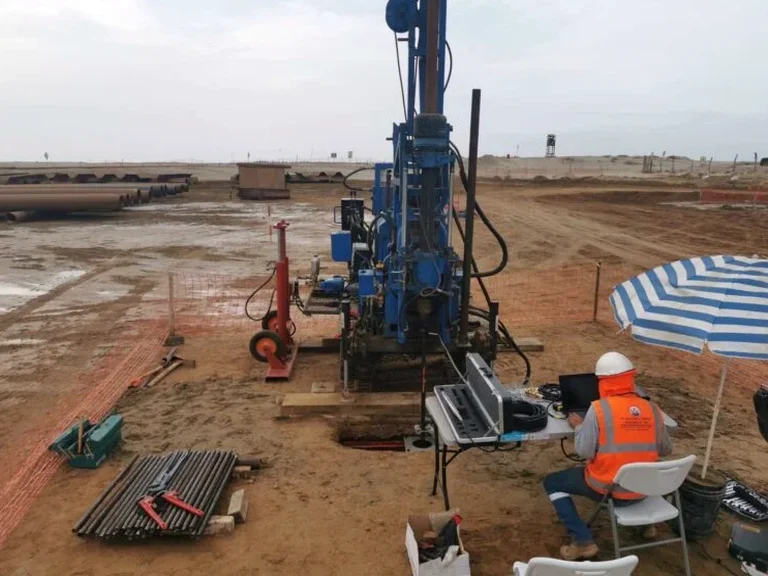
The most common mistake we see with geotechnical investigations in Chilliwack is relying solely on SPT data in the silty floodplain deposits south of the Fraser River. Standard penetration tests can miss thin liquefiable layers and soft clay lenses that cone penetration testing captures with continuous resolution. The Fraser Valley's alluvial stratigraphy—interbedded silts, peats, and loose sands deposited by centuries of river migration—demands a profiling method that does not skip a centimeter. In our experience across projects from Sardis to downtown, combining CPT soundings with selective SPT drilling provides the depositional detail that discrete sampling alone cannot deliver. Chilliwack's 2021 flood event reminded everyone how variable subsurface drainage can be, and CPT data helps us map those high-water-table zones before excavation begins. For sites near Vedder Canal or within the City's expanding industrial parks, the cone's pore pressure transducer gives early warning on drainage behavior that affects both construction staging and long-term foundation performance.
A single CPT sounding in Chilliwack's alluvial corridor replaces roughly 15 SPT samples while delivering pore pressure data that discrete testing cannot match.
Site-specific factors
A three-phase residential development off Chilliwack Central Road encountered a 1.2-meter peat layer at 5 meters depth that preliminary boreholes had logged as organic silt with moderate strength. The developer had already tendered for shallow footings based on the initial report. We mobilized the CPT rig within 48 hours and ran four soundings across the site grid. The cone profile showed a sharp drop in tip resistance from 8 MPa to 0.4 MPa within a 1.5-meter vertical interval, with excess pore pressure ratios exceeding 0.7 during penetration—classic response of fibrous peat under undrained loading. The friction ratio spiked above 5%, confirming the organic nature of the deposit. That data forced a redesign to driven piles bearing in the underlying Sumas till, adding about 12% to foundation costs but preventing what would have been differential settlements exceeding 80 millimeters within the first five years. In Chilliwack's floodplain, skipping CPT because SPT is cheaper often means paying for it later through litigation or remediation. The continuous profile catches what spaced sampling misses: thin, weak seams that control settlement behavior.
Reference standards
ASTM D5778-20 (Standard Test Method for Electronic Friction Cone and Piezocone Penetration Testing of Soils), ASTM D6067/D6067M-17 (Standard Practice for Using the Electronic Piezocone Penetrometer for Environmental Site Characterization and Estimation of Hydraulic Conductivity), NBCC 2020 Division B, Part 4 (Seismic design provisions, site class determination), CSA A23.3-19 (Design of concrete structures, foundation requirements)
Frequently asked questions
How much does a CPT test cost in Chilliwack?
CPT testing in the Chilliwack area typically ranges from CA$250 to CA$320 per sounding meter, depending on depth, site access conditions, and whether seismic cone (SCPTu) or dissipation testing is included. Mobilization costs are additional and vary with location—sites in Greendale or along Yale Road with tight truck access may require smaller rigs that affect the rate. We provide firm quotes after reviewing your site plan and project requirements.
What depth can CPT reach in Chilliwack soils?
In the alluvial silts and sands of the Chilliwack floodplain, our 20-tonne direct-push rig typically reaches 20 to 28 meters before refusal. In upland areas underlain by Sumas till—a dense, overconsolidated glacial deposit with gravel and cobbles—refusal often occurs between 12 and 18 meters. We discuss expected refusal depth during the quoting stage based on nearby borehole logs and surficial geology mapping.
Is CPT better than SPT for Chilliwack projects?
Neither method is universally better, but CPT excels in Chilliwack's layered alluvial environment where continuous profiling catches thin compressible seams and liquefiable lenses that spaced SPT samples can miss. CPT provides tip resistance, sleeve friction, and pore pressure data at 50-millimeter intervals. However, SPT recovers actual soil samples for visual classification and lab testing. Most of our Chilliwack investigations use a combination: CPT for detailed profiling and select SPT boreholes for sampling confirmation.
Do you provide CPT data in digital format for design engineers?
Yes, every CPT sounding is delivered as a digital data file compatible with common geotechnical software packages including CPeT-IT, gINT, and OpenGround. The file contains depth-referenced tip resistance, sleeve friction, pore pressure, friction ratio, and soil behavior type classification at the full 50-millimeter sampling interval. Seismic CPT data includes shear wave arrival times and calculated Vs profiles. We typically deliver raw data within 24 hours of field completion, with interpreted reports following within three to five working days.