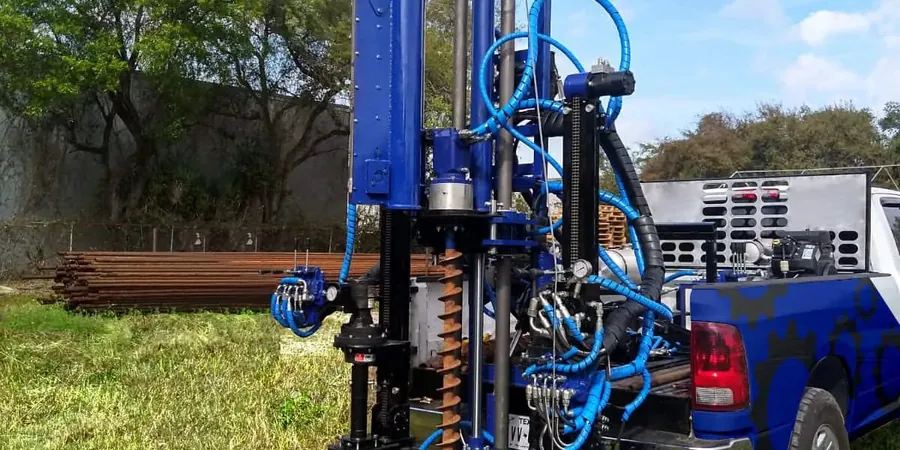
In Chilliwack, the first 15 to 20 feet of subsurface material often tells the whole story of the Fraser River's historic meandering. We routinely see interbedded layers of soft silt and loose sand that can be deceivingly competent at the surface but collapse under dynamic load. Running a Standard Penetration Test here is not just about ticking a box on the geotechnical checklist; it is about quantifying exactly how the local floodplain deposits will behave when subjected to the seismic demands of the Cascadia Subduction Zone. The SPT, executed in accordance with ASTM D1586-18, gives us a direct measurement of the penetration resistance (N-value) that dictates foundation design in Vedder Crossing and throughout the valley. Because the city sits on a complex mix of post-glacial and alluvial sediments, correlating N-values with liquefaction susceptibility becomes a critical step before any structural load is applied to the ground.
A raw N-value of 8 in saturated Chilliwack silt means something entirely different than an N-value of 8 in dense Ontario till—local correction factors are non-negotiable.
Our approach and scope
Chilliwack's urban expansion from a small agricultural settlement into a growing Fraser Valley hub has pushed development onto terrains that were historically bypassed due to poor soil conditions. The geotechnical consequence is that we now drill through thick sequences of normally consolidated clays and silts that exhibit sensitivity and potential strength loss upon remolding. The SPT procedure provides a disturbed sample in a standard split-spoon sampler driven 18 inches by a 140-pound hammer falling 30 inches. We record the blow counts for each 6-inch increment; the sum of the last 12 inches is the N-value. In the eastern sections of the city, near the Cascade foothills, we encounter dense glacial till where N-values routinely exceed 50 blows per foot, signaling refusal and the need for heavy-duty excavation equipment. For sites near the Vedder Canal, where groundwater is high and fine sands dominate, we correct raw N-values for overburden pressure and hammer energy efficiency to derive N1(60) values suitable for liquefaction triggering analysis per Youd and Idriss (2001) procedures. The data feeds directly into bearing capacity equations and settlement predictions, making the SPT the backbone of our subsurface investigation program in the region.
Site-specific factors
Under the National Building Code of Canada (NBCC 2020) and CSA A23.3, seismic site classification in Chilliwack hinges significantly on SPT N-values measured in the upper 30 meters of the soil column. A misinterpreted blow count in a loose sand layer can lead to a Site Class D designation when a Site Class E is more appropriate, or vice versa, fundamentally altering the seismic design forces on a structure. The risk is magnified in areas underlain by the Sumas Drift, where rapid facies changes mean that two boreholes spaced 20 feet apart can yield N-values that differ by 15 blows or more. Failing to account for the presence of scattered cobbles and boulders within the glacial outwash can produce misleadingly high blow counts, masking a weaker matrix material that will compress under load. In the silty floodplain deposits south of the Trans-Canada Highway, low N-values combined with a shallow water table create a classic liquefaction scenario; without rigorous SPT data to constrain the cyclic resistance ratio, a foundation design is essentially a gamble on post-earthquake settlement.
Frequently asked questions
What is the typical cost range for an SPT investigation at a single-family residential lot in Chilliwack?
For a standard residential lot requiring two boreholes to depths of 20-30 feet with SPT sampling at 5-foot intervals, the cost typically falls between CA$680 and CA$880, including a factual geotechnical report. The final price varies depending on access constraints, traffic control requirements, and the presence of thick cobble layers that slow drilling progress.
How do you handle the dense cobble layers in the Sumas Drift during an SPT?
The Sumas Drift presents a practical challenge because large clasts can damage the split-spoon sampler and produce artificially high blow counts. We switch to a solid-cone tip or a heavier drive shoe when refusal is encountered in cobble-rich zones, and we note the refusal depth and driving resistance. In some cases, we advance the borehole with a roller-cone bit through the boulder zone and resume SPT sampling in the underlying finer-grained strata.
How many SPT boreholes does the City of Chilliwack require for a building permit?
The City of Chilliwack's building bylaw typically defers to the professional geotechnical engineer's judgment based on the NBCC and the EGBC Professional Practice Guidelines. A standard Part 9 residential building on a uniform lot may require one to two boreholes, while larger Part 3 structures, commercial developments, or sites with known variable geology often need a minimum of three to four boreholes distributed across the building footprint to capture lateral stratigraphic variability.
Can the SPT N-value alone determine the bearing capacity for a shallow footing in Chilliwack?
Yes, for preliminary design, the corrected SPT N-value is a widely accepted input for empirical bearing capacity equations by Terzaghi and Peck, and for settlement estimation methods such as Burland and Burbidge. However, in the sensitive silts and organic clays present in parts of Chilliwack, we always supplement SPT data with laboratory consolidation and undrained shear strength tests to verify the empirical correlations and avoid underestimating long-term settlement.