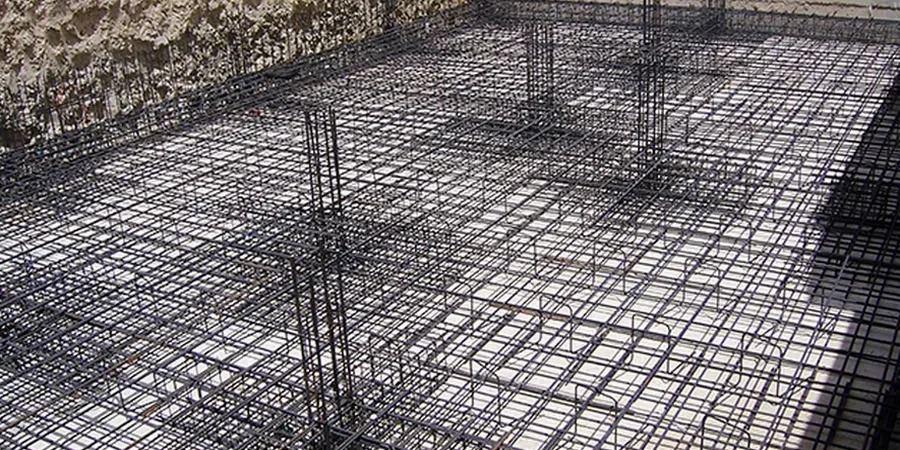
Chilliwack’s development pattern shifted dramatically after the 1948 Fraser River flood, when the dyking system was rebuilt and the eastern sections of the valley floor became viable for industrial and residential expansion. The alluvial sediments that define the local subsurface—interbedded silts, sands, and occasional organics—create a foundation environment where differential settlement governs design from the first borehole log. Mat and raft systems distribute structural loads across a continuous footprint, which makes them particularly effective on the compressible deposits found south of the Trans-Canada corridor. Our lab correlates consolidation parameters from grain-size analysis with field SPT data to constrain modulus values for the immediate bearing stratum, while triaxial testing on undisturbed Shelby tube samples provides the strength envelope needed for bearing capacity verification under the NBCC 2020 load combinations.
A mat foundation on Chilliwack silt is a settlement negotiation, not a bearing capacity exercise—ignore the consolidation curve and you design for failure.
Site-specific factors
A recurring mistake we encounter on Chilliwack projects is the assumption that a mat foundation eliminates the need for deep groundwater control. Builders will pour a thickened-edge raft directly over a prepared granular pad without installing underslab drainage, and within one wet season the slab experiences edge heave from capillary rise in the silt subgrade. The frost penetration depth in the eastern Fraser Valley reaches 600 mm, and when combined with a perched water table at two meters, the cyclic wetting-drying under the slab perimeter generates enough differential movement to crack partition walls. The Geotechnical Engineer of Record must specify a free-draining crushed stone layer at least 300 mm thick, separated from the subgrade by a non-woven geotextile, and tie the drainage stone into a sump or gravity outfall. Another common oversight is neglecting the construction sequence: the mat reinforcement cage often sits directly on the mud mat without adequate cover blocks, leading to bottom-cover deficiencies that are impossible to correct after the pour.
Frequently asked questions
When is a raft foundation preferable to isolated footings in Chilliwack soil conditions?
A raft or mat becomes the logical choice when the allowable bearing pressure is below 100 kPa or when the total footing area for a conventional system would exceed 50 percent of the building footprint. In Chilliwack this happens frequently on the compressible silts north of the Trans-Canada Highway, where isolated footings would require impractically large dimensions to control differential settlement. The continuous slab also provides a rigid diaphragm that bridges local soft spots, which are common in alluvial deposits with discontinuous sand lenses.
How do you determine the modulus of subgrade reaction for a mat foundation design?
We derive the modulus of subgrade reaction (kv) through a combination of field plate load tests following ASTM D1195 and back-calculation from consolidation test data using the Vesic equation. For preliminary design stages in Chilliwack, we correlate kv with SPT N60 values corrected for overburden pressure, but the final design value always comes from site-specific testing because the relationship between N-value and kv is highly sensitive to soil type and stress history. The structural engineer uses this kv to define the spring stiffness in the finite element model of the mat.
What does a mat foundation design package cost for a typical Chilliwack project?
A complete geotechnical package for raft/mat foundation design in Chilliwack—including field drilling, laboratory consolidation and strength testing, bearing capacity analysis, settlement prediction, and the subgrade preparation specification—typically ranges from CA$1,580 to CA$6,340. The final cost depends on the number of boreholes required by NBCC, the depth of investigation, and the complexity of the laboratory testing program. Projects with seismic site-specific response analysis or finite element slab modeling fall toward the upper end of the range.
What laboratory tests are essential before designing a mat foundation in the Fraser Valley?
The minimum laboratory program includes moisture content, Atterberg limits, grain-size distribution by sieve and hydrometer, and one-dimensional consolidation testing on undisturbed samples from each distinct soil layer within the zone of influence. For mat foundations on the silts common in Chilliwack, the consolidation test is the most critical because it provides the compression index (Cc), recompression index (Cr), and coefficient of consolidation (Cv) that directly feed the settlement calculations. We also recommend unconsolidated-undrained triaxial tests to confirm the undrained shear strength used in bearing capacity verification.